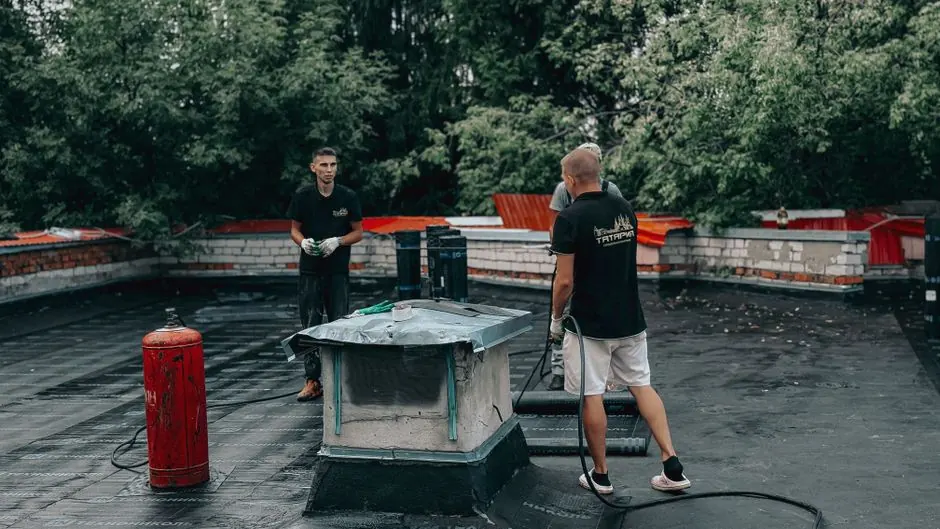
Full Tear-Off and Haul-Away
We strip the old membrane and any wet insulation down to the roof decking, then load it into dumpsters and haul it off. No layering new membrane over failed material, which traps moisture and shortens the new roof's life.
Every full flat roof installation includes tear-off, deck inspection, new insulation, membrane, flashing, and cleanup. Repairs cover the failed area plus a water test. Permits and manufacturer warranty registration are handled by us. What we do not do is coat a dead roof and call it fixed, and we will tell you straight when replacement is the only honest answer.
We strip the old membrane and any wet insulation down to the roof decking, then load it into dumpsters and haul it off. No layering new membrane over failed material, which traps moisture and shortens the new roof's life.
Every square foot of decking gets walked and probed for soft spots. Rotted plywood, delaminated sheathing, and damaged fascia get replaced and nailed off before anything new goes down. We document what we replaced with photos.
We install polyiso insulation with tapered panels and crickets to build positive slope toward drains and scuppers. This is the step that prevents ponding water, and it is the step cheap crews skip to save a day of labor.
New TPO or EPDM membrane gets mechanically fastened and heat-welded or spliced, with prefabricated flashing at every pipe, curb, and wall. New drip edge runs the full perimeter, and all terminations are sealed with roof cement.
We flood-test the roof or run a hose over every drain and seam, then sweep the property with a magnetic sweeper for nails and scraps. You walk the finished roof with the foreman before we hand over warranty paperwork.
Flat Roofing in Connecticut is the design, installation, and repair of low-slope roof systems that use continuous membrane sheets instead of overlapping shingles. Most flat roofs here run a 1/4-inch-per-foot pitch, so water moves slowly and every seam matters. We install TPO membrane, EPDM membrane, and modified bitumen over new roof decking, with tapered insulation to push water toward the drains. Flashing, drip edge, and terminations get sealed with roof cement and heat-welded seams, not caulk and hope.
Connecticut flat roofing takes a beating. Freeze-thaw cycles open seams in February, ice dams back water up under the membrane, and summer storms drive rain sideways through flashing failure. A flat roof installation Connecticut homeowners schedule in spring often prevents the leak they would otherwise find in January. If you have been searching flat roof installation near me Connecticut and getting thin one-page pitches, you already know the difference between a real membrane job and a patch.
Every flat roof job follows the same five steps, whether it is a 400-square-foot garage in Terryville or a 6,000-square-foot commercial building in Hartford. You know what happens each day before we start.
Schedule
Call or book online — a real human picks up and confirms a 2-hour arrival window.
Diagnose
Licensed tech inspects on-site, then walks you through the cause and your options.
Fix
The job is completed to code and done right the first time — no shortcuts, no surprises.
Guarantee
Every job backed by a written workmanship warranty — and we stand behind it.
 Tools & Equipment
Roofing nail gun and air compressor
Fastens insulation boards and membrane plates to the deck quickly and consistently, so fastener spacing matches the manufacturer's wind-uplift spec instead of being eyeballed.
Heat welder for TPO seams
Fuses TPO membrane sheets into a single continuous surface. We probe-test every weld to confirm a minimum 1.5-inch bond before the next course goes down.
Chalk line and tape measure
Lays out membrane courses, flashing heights, and drain locations so the finished roof drains correctly and terminations land where they should.
Pry bar and roofing shovel
Strips old membrane and rolled roofing during tear-off without damaging the decking underneath. Careful removal saves you money on replacement sheathing.
Fall protection harness and ladder
OSHA-required safety gear for every installer on every roof. No exceptions, whether the roof is 8 feet off the ground or 40.
Magnetic sweeper
Runs over the lawn, driveway, and walkways at the end of the job to pick up dropped roofing nails. This is the last thing we do before we leave.
Core sampling
We cut a small sample through the roof to count layers, identify materials, and check for wet insulation. It takes five minutes and tells us whether you need a repair or a replacement, which saves you from paying for the wrong job.
Heat-welded seam testing
Every TPO seam gets probed with a rounded tool along its full length. Any weak spot gets re-welded before the next sheet goes down. This single step is why our membrane callbacks stay under 2 percent.
Tapered insulation design
We lay out polyiso panels in a tapered pattern that builds slope toward drains and scuppers. It costs a bit more in material and adds a day of labor, but it is the difference between a roof that sheds water and one that ponds.
Flood and hose testing
Before we call a job finished, we flood-test the field or run a hose over every drain, seam, and penetration. If water shows up where it should not, we fix it before the warranty is registered.
01
What we do: We tear off all three layers, sister in new framing where the sag is, install tapered insulation, and cap it with 60-mil white TPO. The porch gets a 20-year warranty and stops being the reason the front ceiling stains.
→ A flat, dry porch roof that drains properly and adds a documented upgrade to the home's resale file.
02
What we do: We clean and rebuild the drain assemblies, add crickets to redirect flow, and install a new EPDM membrane over fresh insulation. We also set up a twice-a-year drain cleanout schedule so the problem does not come back.
→ No more ponding, no more tenant ceiling complaints, and a maintenance plan that keeps the warranty valid.
03
What we do: Our emergency crew tarps the roof within hours, then returns with the permanent repair: new membrane, new termination bar, and new drip edge along the exposed edge. We document everything for the insurance claim.
→ Water stops that night, the wall dries out, and the repaired section matches the rest of the roof in color and warranty coverage.
04
What we do: We cut a core sample, confirm the membrane and insulation are saturated, and replace the whole system with a mechanically fastened TPO membrane and new decking where needed. The job takes two days.
→ A dry garage, a 20-year warranty, and no more annual patching bills eating into the equipment budget.
Connecticut flat roofs live in a freeze-thaw climate that most national roofing guides ignore. Water sits in seams, freezes overnight, expands, and opens the bond. That is why we spec 60-mil membrane instead of 45-mil on most homes, and why we build slope into every replacement. Coastal towns like New London and Madison add salt air and wind-driven rain to the mix, so flashing details there get extra attention. Inland, older housing stock in Hartford and Waterbury often has two or three layers of rolled roofing that have to come off before anything new goes down. The state follows the Connecticut State Building Code, and we pull permits and schedule inspections on every structural or full-replacement job. If you have been comparing flat roofing cost in Connecticut quotes, ask each contractor what membrane thickness and insulation R-value they are pricing. The cheap quote usually answers that question for you.
Asylum Hill, Hartford
Dense stock of older flat-roof buildings where multiple roofing layers are common and tear-off depth drives the schedule.
Downtown Shelton
Mix of commercial low-slope roofs and residential additions, with tighter lot access that affects dumpster placement and material staging.
Shoreline Madison
Salt air and nor'easter wind uplift mean flashing and edge termination details get extra fastening and sealant.
Terryville center
Older garages and outbuildings with tar-and-gravel roofs that have reached end of life and need full membrane replacement.
Freeze-thaw cycling from December through March
Opens seams and terminations, so we heat-weld to a wider minimum and inspect every edge detail before winter. Repairs scheduled in fall prevent the January leak call.
Nor'easter wind uplift along the shoreline
Drives membrane peeling at corners and edges. We increase fastener density at perimeters and install new termination bars on coastal jobs.
Heavy tree cover in inland towns
Fills drains and scuppers with leaves each fall, causing ponding. We recommend and can set up twice-a-year drain cleanouts to keep water moving.
Older housing stock with layered roofs
Adds tear-off time and cost, and sometimes reveals rotted decking. We price the tear-off honestly up front instead of surprising you mid-job.
Flat roofs fail in predictable ways, and Connecticut weather accelerates all of them. Here are the calls we run most often, and what it takes to actually solve them instead of postponing the inevitable.
Problem
Standing water works through seams and pinholes, saturates the insulation, and adds structural load. Left alone, it turns a $2,000 repair into a full replacement within two seasons.
Our Fix
We re-slope the roof with tapered insulation and crickets, clear or replace clogged drains and scuppers, and verify flow with a hose test. Water should clear the roof within 48 hours of any storm, and we do not leave until it does.
Problem
Connecticut freeze-thaw cycles push water up under seams and terminations, which shows up as ceiling stains in January and February. By the time you see the stain, the insulation below is already wet.
Our Fix
We repair the failed terminations with new flashing and heat-welded patches, improve attic ventilation with ridge vents, and add ice and water shield at vulnerable edges. If the deck is saturated, we replace that section rather than patch over it.
Problem
A membrane that cracks when you press it will not survive another winter. Patching it every few months costs more over three years than replacing it once, and each patch is a temporary fix on borrowed time.
Our Fix
We cut a core sample to confirm the membrane is at end of life, then quote a full replacement with 60-mil TPO or EPDM and a 20-year manufacturer warranty. You get a fixed number, a schedule, and a roof that stops being a monthly problem.
Problem
Most flat roof leaks start at penetrations, not in the field of the membrane. A failed pipe boot drips straight into the ceiling below and can rot framing and drywall before anyone traces it.
Our Fix
We replace failed boots and curbs with prefabricated flashing pieces, seal terminations with roof cement, and hose-test each penetration individually. That targeted approach fixes the leak without tearing off a roof that still has years left.

A flat roof done correctly buys you decades of service. Here is what our clients actually get when we replace a failing low-slope roof with a warrantied membrane system.
Decades of Service Life
A properly installed 60-mil TPO membrane carries a 20-year manufacturer warranty and routinely lasts 25 to 30 years in Connecticut. Compare that to a tar-and-gravel roof that starts blistering at year 12. We spec the membrane thickness and fastener pattern to your building, not to a one-size price sheet.
No More Ponding Water
Standing water is the number one killer of flat roofs. We install tapered insulation and crickets so water reaches the drain within 48 hours of a storm. If your current roof holds puddles for days, that is a drainage problem we fix during the tear-off, not a coating we roll over.
Leak-Free Seams
Flat roof leaks almost always start at seams, penetrations, and flashing. We heat-weld TPO seams to a minimum 1.5-inch width and test them, then seal pipe boots and HVAC curbs with prefabricated flashing. That is why our callbacks on membrane work run under 2 percent.
Lower Energy Bills
White TPO reflects sunlight instead of absorbing it. On a 1,500-square-foot flat roof, that can drop summer cooling costs by 10 to 15 percent. We pair reflective membrane with ridge vents and proper attic ventilation so heat does not sit trapped under the deck.
Honest 2026 pricing for flat roofing in Connecticut runs $9 to $18 per square foot installed for a full replacement, which puts most residential jobs between $11,000 and $21,000. Repairs land between $450 and $1,800. TPO costs less per square foot than EPDM on large roofs, and small garages sit at the higher end because setup costs spread over fewer squares. We quote line items, not ballparks, and the number you sign is the number you pay unless you approve a change.
Typical Investment Range
$450 - $21,000 depending on repair vs. full replacement and roof size
A flat roof replacement is a 20-to-30-year purchase, so the per-year cost of a properly installed membrane is often lower than patching a failing roof every other season. We give you the line-item price and let you decide with real numbers.
What changes the price
Roof size and access
Larger roofs cost less per square foot because setup and mobilization spread across more area. Tight lots, steep ladder access, or roofs blocked by landscaping add labor and can push the per-square-foot price up by 15 to 25 percent.
Number of existing layers
Every extra layer of old roofing adds tear-off labor and dumpster fees. A single-layer tear-off on a 1,200-square-foot roof runs about a day; three layers can double that and add $1,500 to $3,000 in disposal and labor.
Membrane type and thickness
60-mil TPO costs more than 45-mil but lasts years longer and carries a better warranty. EPDM prices close to TPO on large roofs. Modified bitumen is the budget option for small porches and garages where lifespan matters less.
Insulation and drainage work
Tapered polyiso insulation and crickets add material and a day of labor, but they are what stop ponding. Skipping them saves money now and costs you a premature replacement later, which is a bad trade every time.
Decking repairs
Rotted plywood, delaminated sheathing, and damaged fascia get replaced at a per-sheet price. We document what we replace with photos, so you can see exactly where the money went and why.
Flashing and penetration count
Every pipe boot, HVAC curb, skylight, and wall termination adds detail labor. A roof with a dozen penetrations takes longer to flash correctly than a clean field, and we price each one rather than hiding it in a lump sum.
Google ★★★★★4.9
They replaced our flat garage roof with TPO and it has been bone dry for two winters. The foreman showed me the core sample and explained why patching was a waste of money. Honest crew, clean site.
Google ★★★★★4.8
Tarped our leaking flat roof the same night we called, then came back with the permanent fix. Price matched the estimate exactly. They know low-slope roofs, which is rare around here.
BBB ★★★★★4.9
Managed a commercial flat roof replacement with them. Four days, no tenant complaints, and the warranty came registered in the building's name. Drainage is night and day better than before.
Yelp ★★★★★4.7
Got three quotes for our flat addition roof. RoofPros was the only one who cut a core sample before pricing. That told me everything. New TPO membrane, new flashing, and they swept the yard for nails.
Our crews work flat roofs every week, not once a season. That matters, because low-slope work is a different trade than shingle roofing. We hold a CT HIC license, carry OSHA safety certification for every installer, and are an NRCA member. Our foremen are trained on Firestone, Carlisle SynTec, and Versico membrane systems, and we install GAF and Owens Corning products on the steep-slope side of the business. Every job gets a fall protection harness, a dedicated safety plan, and a manufacturer warranty registered in your name.
Our flat roofing crews cover the whole state, from the Hartford metro down through the shoreline and up into the Quiet Corner. Whether you need a flat roof installation Connecticut homeowners can schedule this week or a commercial membrane replacement, we route a foreman to your town with the right membrane and flashing on the truck.
Flat roofs on Bethany garages and additions get TPO membrane with tapered insulation, sized for the wooded lots and heavy fall leaf drop that clogs drains.
Brookfield homeowners call us for flat roof repair Connecticut work on porch and addition roofs, plus full membrane replacements when the old rolled roofing has reached end of life.
Cos Cob's older homes often mix flat porch roofs with shingle main roofs. We handle both, installing TPO on the low-slope sections with coastal-grade flashing details.
East Hartford has a deep stock of flat-roof buildings. We tear off layered roofing, repair decking, and install new membrane systems with proper drainage toward scuppers.
Georgetown properties with flat garage and addition roofs get 60-mil TPO and new drip edge, built to handle the freeze-thaw cycling that opens seams each February.
From Asylum Hill to the South End, we run flat roofing crews across Hartford for residential and commercial low-slope roofs, pulling permits and scheduling inspections.
Madison shoreline roofs take wind-driven rain and salt air. We increase fastener density at edges and install new termination bars on every coastal flat roof job.
Moodus homeowners get flat roof installation near me Connecticut service for garages and outbuildings, with membrane systems sized for rural lots and heavy tree cover.
New London commercial and residential flat roofs get EPDM and TPO membrane systems, with drain rebuilds and crickets to stop the ponding that plagues older buildings.
North Windham flat roofs get full tear-offs, deck repairs, and new insulation. We handle the layered rolled roofing common on older homes in the Quiet Corner.
Orange property owners call for flat roof repair Connecticut service on leaking pipe boots and flashing, plus full replacements with 20-year manufacturer warranties.
Redding Center's wooded lots mean debris-filled drains. We install tapered insulation and set up cleanout schedules so flat roofs keep shedding water year-round.
Shelton's mix of commercial buildings and residential additions gets membrane systems with tight-lot staging handled by our crews, dumpsters and all.
Stafford Springs flat roofs face hard inland winters. We spec 60-mil membrane and ice and water shield at vulnerable edges to survive the freeze-thaw season.
Terryville garages and outbuildings with aging tar roofs get full membrane replacements, usually in two days, with new decking where the old roof has rotted through.
Real answers to the questions we hear most often from local homeowners and property managers.
New construction and full tear-off installations for homes and commercial buildings. We handle the decking, underlayment, and membrane in one pass, so your flat roof starts its warranty life with zero inherited problems.
View Roof InstallationWhen a flat roof is past patching, we tear it down to the deck and rebuild with new insulation and membrane. Most replacements take three to five days and come with a 20-year manufacturer warranty registered in your name.
View Roof ReplacementTargeted fixes for flashing failure, punctures, and seam separation on low-slope roofs. We heat-weld patches and replace failed terminations, then water-test the area before we leave so the repair actually holds.
View Roof RepairLeak tracing on flat roofs takes patience, because water travels. We use hose testing and infrared checks to find the true entry point, then repair it properly instead of coating the ceiling stain from above.
View Roof Leak RepairA 45-minute inspection with photos, a core sample, and a written condition report. Ideal before buying a property with a flat roof, or each fall before winter locks the roof in ice.
View Roof Inspection24/7 tarp-over and emergency stabilization after storms. We secure the membrane, stop active leaks, and schedule the permanent repair, so a bad night does not turn into a ruined ceiling.
View Emergency Roofing ServicesCall (844) 720-2263 any time, day or night. For routine estimates we answer between 7 a.m. and 7 p.m., and emergency calls roll straight to a live dispatcher. You can also send photos of your roof through the website and we will reply with a ballpark range before we come out.
Phone
(844) 720-2263Address
Connecticut
Hours
Mon–Fri: 7AM – 7PM
Sat: 8AM – 4PM
Sun: Emergency Only
24/7 Emergency Available